Document |
1. Overview |
|
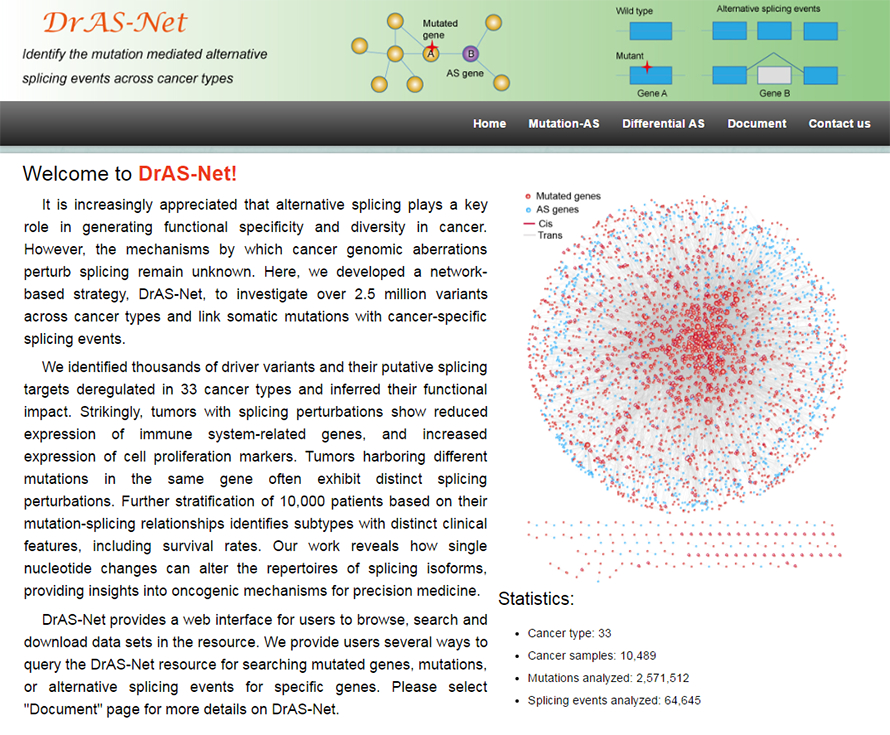
Welcome to DrAS-Net! Alternative splicing (AS) is a highly regulated process that adds complexity to human transcriptome, proteome and signal transduction networks in the cell. Tissue- and cell-type specific AS patterns have been shown to play critical roles in development and differentiation. Aberrant AS events have been implicated in complex diseases, including various types of cancer. In the complex realm of human proteome, to what extent do genomic aberrations underlie functionally different splice isoform formation? How widespread are splicing alterations contributing to oncogenic signaling? How might genomic mutation-mediated alternative splicing lead to functional and phenotypic diversity? To start addressing these questions, we have developed a systems-level multi-scale framework (DrAS-Net) to investigate driver mutation candidates that elicit splicing perturbations across cancer types. We identified over thousands of driver variants and their putative splicing targets deregulated in 33 cancer types and inferred their functional impact. Strikingly, tumors with splicing perturbations show reduced expression of immune response-related genes. Tumors harboring different mutations in the same gene often exhibit distinct splicing perturbations. Further stratification of 10,000 patients based on their mutation-splicing relationships identifies subtypes with distinct clinical features, including survival rates. This work reveals how single nucleotide changes can alter the repertoires of splicing isoforms, providing insights into patient-specific oncogenic mechanisms for precision medicine. To facilitate the users to obtain the mutation-AS information, we constructed this resource-DrAS-Net (Figure-1). |
|
|
|
2. Methods |
|
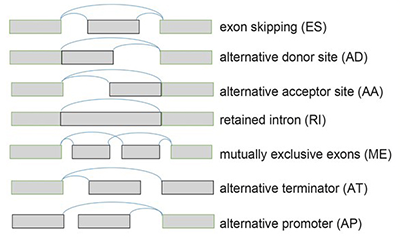
Identification of the differential AS landscape across cancer types. The Percent Spliced In (PSI) value was used for quantifying splicing events, which is defined as the number of reads indicating that a transcript element is present divided by the total number of reads covering the AS event. In total, the PSIs for 10,699 samples across 33 types of cancer were obtained, including 749 normal samples for 23 types of cancer. Seven types of AS events were considered in our analysis (Figure-2), including exon skipping, alternative donor site, alternative acceptor site, retained intron, mutually exclusive exons, alternative terminator and alternative promoter. Wilcoxon rank-sum test was used to identify the differential AS events in each cancer. P-values were corrected by BH method. |
|
|
|
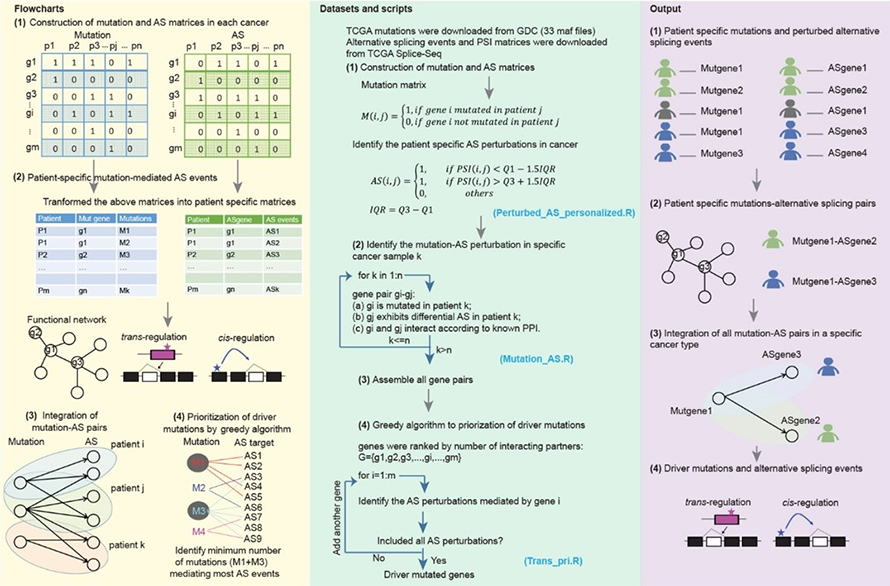
DrAS-Net. We developed an integrated analysis framework to identify the mutation-mediated AS in cancer. This approach relates genomic mutations to AS patterns, informed by known interactions between genes (Figure-3). Firstly, mutation (blue) and differential AS (green) matrices are constructed. Next, patient-specific mutation-mediated AS events are identified based functional network structure. All mutation-AS pairs are assembled as a bi-graph and a greedy search method is used to identify driver mutations and AS events. |
|
|
|
3. Step by step usage of this resource |
|
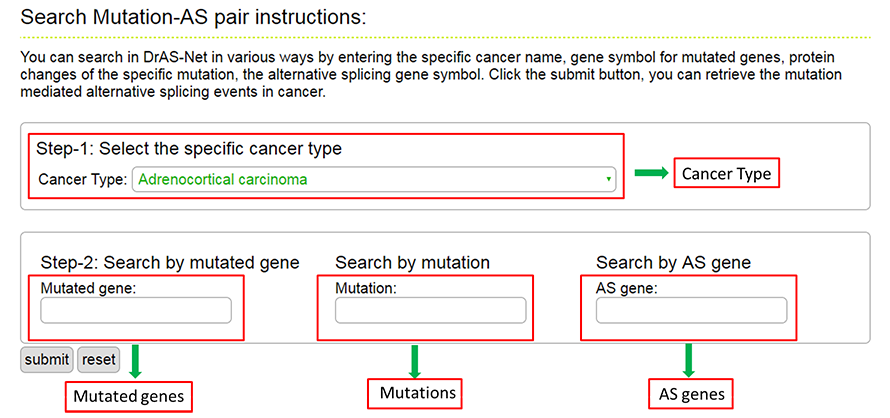
Here is a step to step introduction about how to use the web to search the mutation and alternative splicing events in cancer. The users can search the mutation-AS identified in 33 cancer types in this web. At the same time, the users can obtain the perturbed AS information between cancer and normal samples. Search the mutation-AS in specific cancer The DrAS-Net provides an interface to retrieve the information about the mutation-AS events in cancer. The current release of DrAS-Net mainly contains the results in 33 types of cancer. Users can search by individual mutated gene or by individual mutation or by individual AS gene to view the mutation-AS association in a certain cancer (Figure-4). Here, we provide an example where users can click on "examples" and "submit", to check out the information about mutation and AS events. |
|
|
|
The users can obtain the mutation-AS information in a specific cancer type, and click the detail button will retrieve the detail information (Figure-5). |
|
|
|
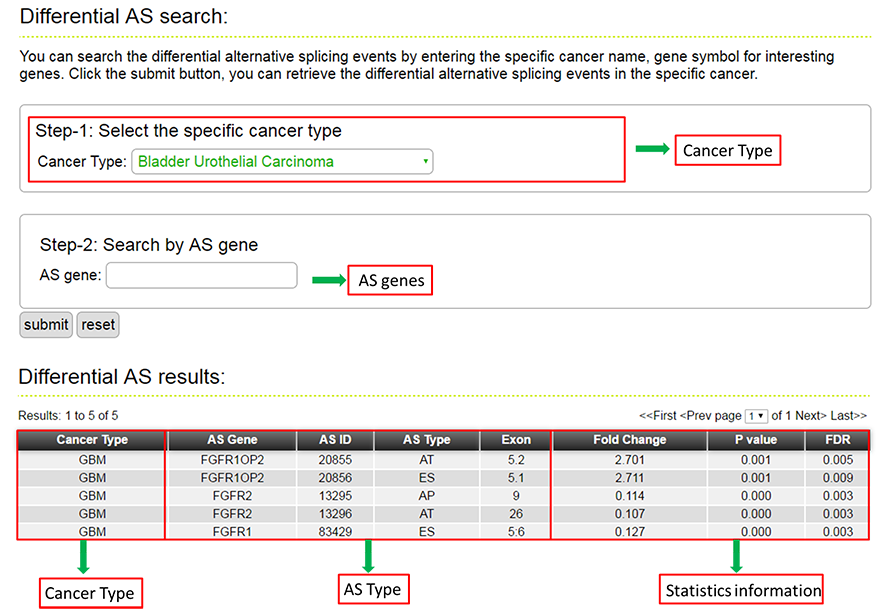
Search the perturbed AS events in specific cancer The DrAS-Net also provides an interface to retrieve the information about the perturbed AS events in cancer (Figure-6). Users can search by individual AS gene to view the perturbed AS events in a certain cancer type (Figure-7). |
|
|
|
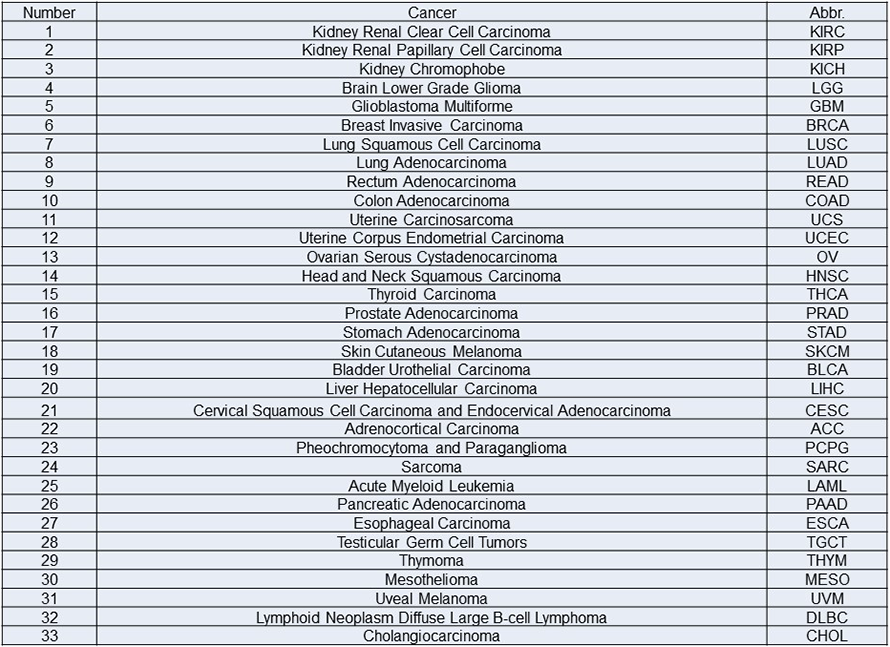
4. Cancer name abbreviations |
|
|
|
5. Download |
|
All the information in this resource can be downloaded for further bioinformatics analysis. The R scripts of DrAS-Net can also be downloaded at GitHub https://github.com/lyshaerbin/DrASNet. |